
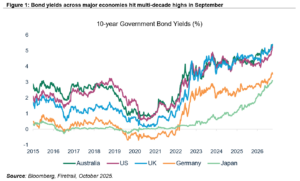
Bond yields have been rising. Fast. 10-year government bond yields in the US hit the highest levels in almost 25 years. Japan’s 10-year yield crossed 3% for the first time since 1996. Australia’s 10-year reached its highest level since 2011. Longer-dated bonds tell the same story. In October, UK 30-year yields topped 6%. The chart below shows how far 10-year yields have climbed and demonstrate it’s a global issue.
What’s driving the increase in long-dated government bond yields?
Several forces have been pushing bond yields higher in recent times. Three stand out to us:
- Global uncertainty – Lending to a government for 10 or 30 years is a bet on what the world will look like over that time. Wars in Ukraine and the Middle East, rising trade barriers and Trump’s unpredictable policymaking have clouded the long-term outlook. As a result, bond investors are demanding higher yields to compensate for the increased levels of uncertainty.
- High inflation – Inflation has run above target in most major economies for over 5 years. Higher oil prices are adding more pressure. In September, 6 major central banks raised rates including the US Federal Reserve, European Central Bank, Bank of Japan and the RBA. Higher short-term rates plus the expectation of more increases flow through to long-term yields.
- AI capex boom – AI capital spend is funded mainly with debt. Goldman Sachs estimates AI borrowers are making up around 18% of investment-grade bond issuance this year, up from 7% in 2025. A large portion of AI-related bonds are long-dated, putting them in direct competition with long-dated government bonds. More bonds chasing the same money pushes yields higher.
So why is this relevant to us as equities investors?
Government bond yields underpin the price of almost every other asset because they set the “risk free rate”. Governments are seen as extremely unlikely to default on their borrowing, so every other asset needs to offer a higher return than bond yields to be worth the added risk.
So when bond yields rise, it affects equities in a few ways:
- Bonds become real competition – with Australian government bonds paying more than 5%, shares look less compelling, particularly for investors who own them for income.
- Future earnings are worth less today – The more investors can earn from bonds, the less they’ll pay today for earnings that arrive years from now. Expensive growth stocks, which rely most on those future earnings, feel it most.
- Debt gets more expensive – heavily geared companies face bigger interest bills when they refinance.
In theory, rising yields should push share prices down. But this hasn’t been the case so far. US and Australian shares were both close to record highs as recently as August. In our view, strong earnings growth and a resilient economy have so far outweighed the drag from higher yields.
How is this affecting the way we are investing at Firetrail?
With bond yields at multi-decade highs, we favour companies with manageable debt, robust cash flows and durable competitive advantages.
That said, as with any macro event, we don’t have a crystal ball and can’t know where bond yields go from here. So our overall approach doesn’t change: we stay fully invested, we don’t try to time the market, and we rely on bottom-up, fundamental research so our portfolios are driven by stock-specific outcomes rather than macro factors outside our control.
Companies mentioned are illustrative only and not a recommendation to buy or sell any particular security.