Much of the attention on AI has gone to the powerful GPU chips used to train models and generate answers. September provided another reminder that more capable AI also needs more of the equipment around those chips, providing broader investment opportunities.
Think about asking an AI agent to organise a trip. It might search for flights, compare hotels, check your calendar and work through several booking options. There is quite a lot of “traditional” computing involved before an itinerary comes back. There is the “thinking” of GPUs and the “doing” of conventional computing.
These conventional processors, known as CPUs, handle much of this supporting work. In September, AMD explained how CPUs retrieve information, run software tools and coordinate tasks between agents. TSMC made a similar point in its July results, highlighting the additional demand for CPUs as AI agents become more widely used. Compared to a year ago, the market now realises a large volume of CPUs is required. This creates another opportunity for companies that design and manufacture these chips, in an already capacity constrained environment.
The networking also needs to keep up. Expensive processors are less useful if they spend too much time waiting for information. Faster networks help move data around, but each new generation needs to be designed, tested and checked before customers can rely on it.
Portfolio holding Keysight’s September update showed how quickly this is moving. Ahead of a September conference, it outlined testing for networking connections is at double the current speeds being installed in data centres and chips, while researching networking testing is at double this again. Networking speeds are a bottleneck that Keysight is helping to solve.
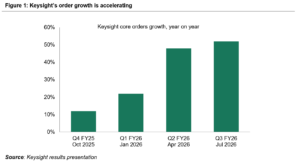
Keysight’s results show how demand for its products has accelerated. Core orders grew 52% from a year earlier in the quarter ending July, compared with 12% growth in the quarter ending October 2025. These are company-wide figures, although management identified AI infrastructure as an important driver and said wired communications orders had more than doubled.
Three Fund holdings that give us exposure to this AI arms race capex spending were top contributors to fund performance in September. AMD designs processors, TSMC manufactures chips and Keysight helps customers test the systems they go into. The pace of investment is strong across the AI hardware chain, and strong orders still need to become revenue and earnings. For us, the opportunity is to find businesses whose earnings can grow, at attractive valuations, as these less visible parts of AI infrastructure become more important. The opportunities are spread right across the world.
Companies mentioned are illustrative only and not a recommendation to buy or sell any particular security.